

Latest Clarifications on the $100,000 H-1B Visa Fee (as of October 2025)
Following official updates from the U.S. Citizenship and Immigration Services (USCIS), several key points have been clarified regarding implementation of the new supplemental H-1B filing fee introduced under the September 2025 Presidential Proclamation.
Confirmed by USCIS
- Effective Date:
The $100,000 supplemental fee applies to new H-1B petitions filed on or after 12:01 a.m. EDT, 21 September 2025.
Source: USCIS — H-1B Specialty Occupations - Fee Type:
USCIS defines this as a one-time supplemental payment, not a recurring or annual charge. - Non-Retroactive Application:
Petitions submitted before 21 September 2025 are not subject to the new surcharge. - Existing H-1B Holders:
Current visa holders maintaining valid status may continue employment, travel, and re-entry without triggering the new fee.
Points Under Legal Review (Pending Further USCIS Guidance)
- Amendments and Transfers:
Immigration law firms note that USCIS has not yet confirmed whether the fee applies to change-of-employer or amendment petitions. - Possible Exemptions:
Legal experts also indicate potential waivers for petitions in the national interest or under cap-exempt categories, pending official USCIS confirmation.
Note: USCIS continues to update guidance for employers and immigration practitioners. For the most accurate details, refer to the official USCIS H-1B Specialty Occupations page.
Key Takeaways
- $100,000 supplemental fee takes effect 21 September 2025 for new petitions only
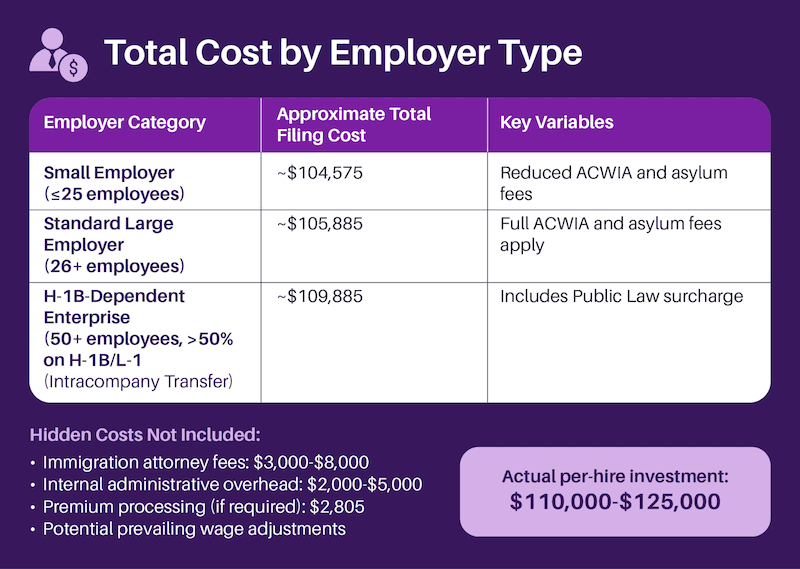
- Total costs exceed $110,000 per hire when including all mandatory fees
- Employers bear 100% of costs — passing fees to employees violates federal law
- Legal challenges pending, but the trend toward higher employer costs is clear
- Global hiring alternatives through Eos Global Expansion’s EOR eliminate visa dependency entirely
The 2025 H-1B Fee Increase: A Watershed Moment for Global Hiring
In September 2025, U.S. immigration policy reached an inflection point with the introduction of a $100,000 supplemental fee for H-1B visa petitions — the most substantial cost increase in H-1B programme history.
This change affects both U.S. employers hiring international talent and international companies expanding into the U.S. With total visa expenses surpassing six figures, many organisations are transitioning toward EOR-based hiring, which provides flexibility, compliance, and scalability without visa dependency.
The New Reality: What once cost $5,000-$10,000 per H-1B petition now approaches $110,000 — a 10-20x increase that forces strategic recalibration across industries from technology to consulting to engineering.
Eos Global Expansion supports this shift, helping employers hire, pay, and manage international employees compliantly in over 27 countries through its Global Employer of Record services.
What Is the New US$100,000 H-1B Supplemental Fee?
Introduced via Presidential Proclamation, this new surcharge represents a policy shift toward employer-funded workforce development and reduced immigration dependency.
At a Glance: The New Fee Structure
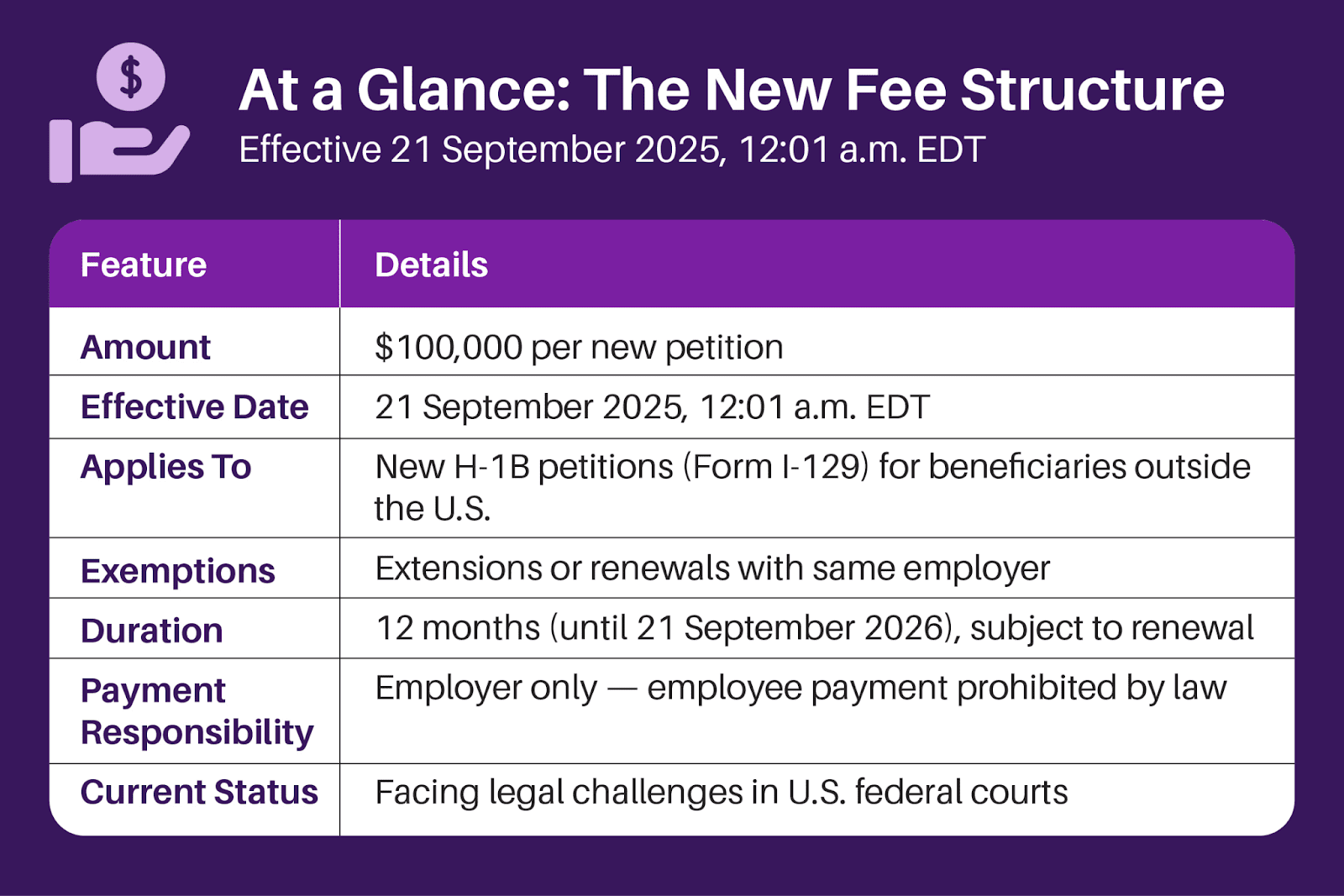
Critical Point: This fee is in addition to all other U.S. Citizenship and Immigration Services (USCIS) and Department of Labor (DOL) filing costs. It doesn’t replace current USCIS requirements but adds an entirely new cost layer that fundamentally changes hiring economics.
Complete H-1B Cost Breakdown: What Employers Actually Pay (2025)
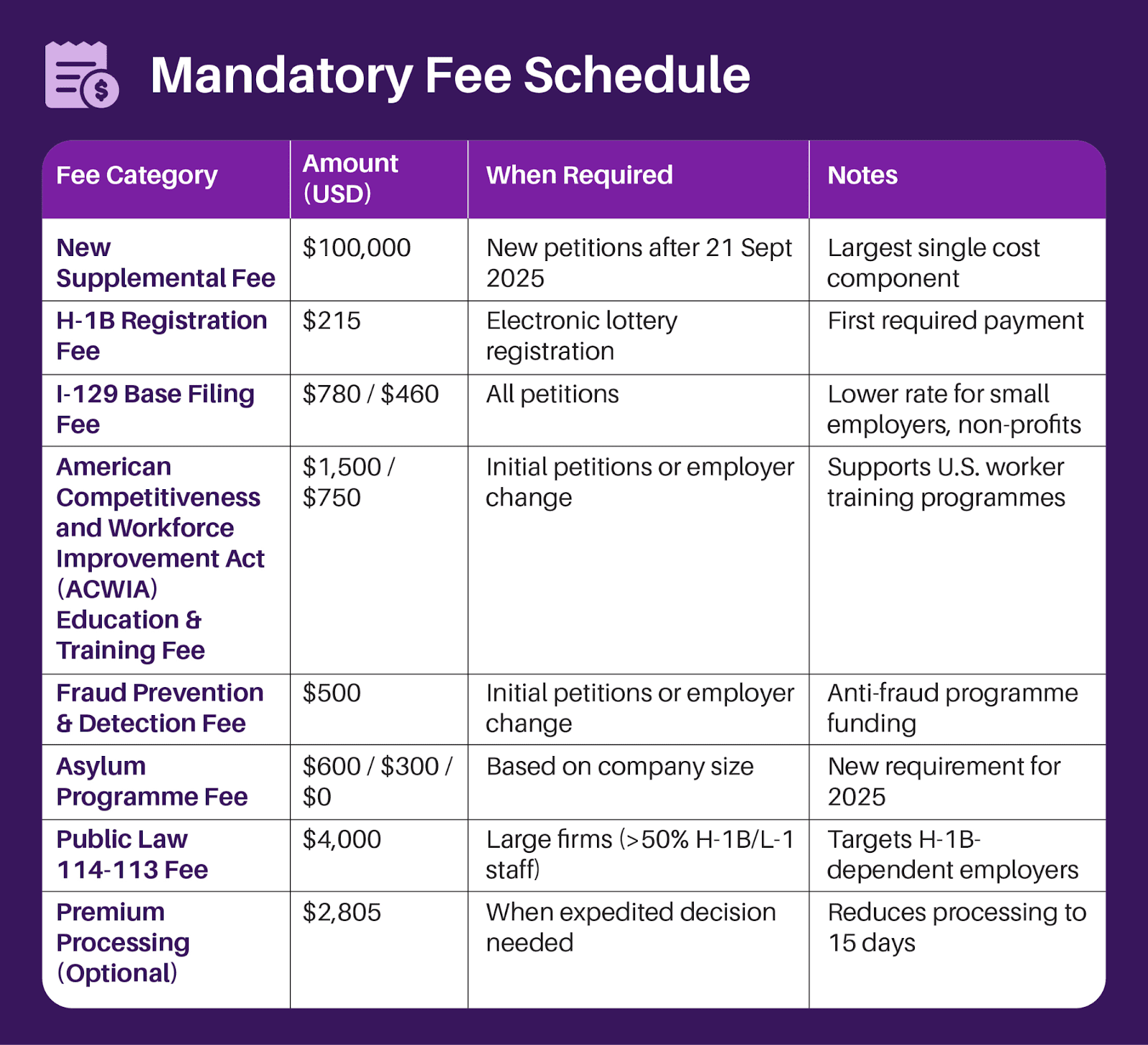
The $100,000 figure represents just one component of total H-1B sponsorship costs. Understanding the complete fee structure is essential for accurate budget planning.
Mandatory Fee Schedule
Total Cost by Employer Type
Who Pays What: Legal Requirements and Compliance Obligations
U.S. immigration law places strict limitations on fee responsibility, creating compliance risks for employers who misunderstand the rules.
Employer Mandatory Costs (Cannot Be Passed to Employee)
Under U.S. federal law, employers are required to pay all mandatory filing fees.
Must Pay:
- All USCIS filing fees including the $100,000 surcharge
- Base I-129 petition costs
- ACWIA training fees
- Fraud prevention fees
- Asylum programme fees
- Attorney fees for petition preparation
Legal Consequence: Any attempt to recover these costs from employee wages violates Department of Labour (DOL) regulations and can result in back-pay orders, petition denials, and future sponsorship disqualification.
Employee Optional Costs (May Voluntarily Pay)
Employees may only pay optional charges such as premium processing or legal fees if voluntarily chosen.
Can Pay:
- Premium processing fees (if employee desires faster decision)
- Personal attorney consultations
- Document preparation assistance
Critical Compliance Point: Even when employees volunteer to cover optional costs, employers must maintain clear documentation showing voluntary payment and cannot make such payment a condition of employment.
Concerned about how rising H-1B costs could impact your hiring plans?
Impact on U.S. Employers: The Cost Reality Check
For American companies — particularly in technology, consulting, engineering, and professional services — the new fee structure significantly raises the cost of sponsoring international talent and shifting international hiring strategies.
What Employers Are Saying
Across HR and industry forums, many employers are now discussing alternatives such as:
- Hiring through Employer of Record (EOR) arrangements,
- Expanding remote teams internationally, and
- Reducing reliance on U.S. visa sponsorships altogether.
Common Refrains:
- “At $110K per visa, we can’t justify H-1B sponsorship for most roles”
- “We’re exploring offshore teams through EOR rather than bringing talent to the U.S.”
- “The math no longer works for junior to mid-level positions”
- “We’re expanding remote teams in lower-cost regions instead”
Eos Global Expansion enables U.S. employers to hire skilled professionals worldwide through compliant local entities — removing visa dependency, avoiding USCIS delays, and ensuring smooth onboarding in weeks, not months.
Strategic Hiring Alternatives
1. Global EOR Hiring
Rather than sponsoring H-1B visas, U.S. companies employ international talent in their home countries through EOR infrastructure, accessing the same expertise at a fraction of the cost.
2. Remote-First International Teams
Technology companies build distributed teams across multiple countries, maintaining productivity whilst avoiding immigration complexity entirely.
3. Nearshore Development Centers
Establishing development hubs in Canada, Mexico, or Latin America provides proximity without U.S. visa requirements.
Through Eos’s global EOR network, U.S. employers hire compliantly in 27+ countries without navigating visa processes, waiting months for petition approvals, or investing six figures per employee.
Explore proven alternatives to H-1B sponsorship: Learn how leading companies are building global teams without visa dependency through strategic EOR partnerships with Eos Global Expansion and cost-effective hiring models.
Impact on International Companies: U.S. Expansion Reimagined
For international companies based in regions such as the United Kingdom (UK), European Union (EU), or Asia, the H-1B fee increase fundamentally changes American market entry economics.
The Traditional Model (Now Prohibitively Expensive)
Old Approach:
- Establish U.S. subsidiary ($15,000-$50,000 setup)
- Sponsor key employees on H-1B visas ($110,000+ per person)
- Wait 6-9 months for visa approvals
- Manage ongoing compliance and renewals
- Total first-year investment: $250,000-$500,000 for 2-3 employees
The Modern EOR Alternative
New Approach Through Eos:
- Engage Eos’s U.S. EOR services (no entity required)
- Hire U.S.-based employees under local compliance
- Begin operations within 1-2 weeks
- Manage payroll and taxes seamlessly
- Total first-year investment: 10-15% of annual salaries
Strategic Advantage: International companies access the U.S. market immediately, test viability with minimal commitment, and scale operations without immigration barriers or entity establishment costs.
Speak to us about Eos’s U.S. expansion solutions for market entry without visa dependency.
H-1B Sponsorship vs EOR Hiring: Comparison
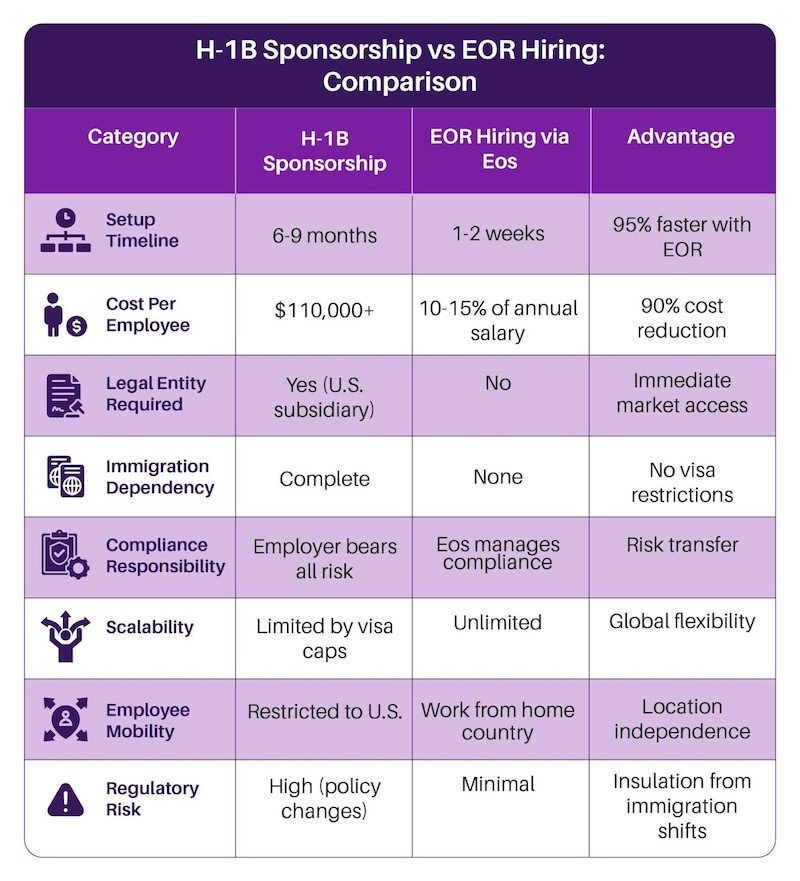
Real-World Scenario: A UK technology company needs a 5-person U.S. sales team:
- H-1B Route: $550,000+ in visa fees alone, 6-9 month wait, ongoing compliance burden
- EOR Route: ~$50,000-$75,000 annual service fees, 2-week deployment, full compliance coverage
Contact Eos Global Expansion now for a customised quote.
Policy Direction: What to Expect in 2026 and Beyond
The 2025 H-1B fee increase signals broader policy trends that employers should anticipate:
- Funding domestic training programmes,
- Reducing employer reliance on foreign labour, and
- Recovering USCIS operational costs through employer surcharges.
If legal challenges fail, similar employer-funded fees may emerge in 2026 and beyond as part of the U.S. government’s workforce protection strategy.
2026 Outlook
Likely Developments:
- Supplemental fee renewal or increase beyond the initial 12-month period
- Expansion of surcharges to L-1, O-1, or other employment-based visas
- Stricter prevailing wage requirements
- Enhanced compliance auditing and enforcement
Strategic Implication: Employers relying heavily on U.S. immigration should diversify hiring strategies now, before additional policy constraints emerge.
Compliance Essentials: Avoiding Costly Violations
The new fee structure intensifies scrutiny on employer compliance. Understanding these requirements prevents penalties, petition denials, and programme disqualification.
Compliance Essentials for Employers
To remain compliant under USCIS and DOL regulations:
- Pay all H-1B-related fees directly from the employer’s account.
- Maintain payment records for all petitions.
- Avoid any reimbursement or cost-sharing arrangements.
- Ensure salaries meet or exceed the prevailing wage set by the DOL.
Failure to comply can result in financial penalties and suspension from future visa filings.
How U.S. Employers Can Adapt: Global Hiring Through EOR
Forward-thinking U.S. companies maintain access to global talent whilst eliminating visa-related costs through strategic EOR partnerships.
With Eos Global Expansion, employers can:
- Hire professionals in Asia, Europe, Africa, and Latin America,
- Manage payroll and employment compliance locally,
- Onboard in as little as one to two weeks, and
- Scale operations without immigration risks.
Real-World Application: A Silicon Valley software company builds a 20-person engineering team across India, Poland, and Brazil for less than the cost of sponsoring two H-1B engineers — with superior talent diversity and zero immigration risk.
Explore Eos’s Global Employer of Record services for visa-free international hiring.
How International Companies Can Enter the U.S. Market Efficiently
For international organisations from the UK, EU, Asia, or other regions, Eos provides a compliant, cost-effective entry into the American market without visa complexity.
Eos’s U.S. Market Entry Solution
Through strategic partnerships, including Hightekers, Eos offers comprehensive U.S. EOR coverage combining compliance expertise, cultural understanding, and dedicated HR support.
Key Capabilities:
- Immediate Market Access
- Hire and manage U.S.-based employees without establishing a local entity
- Begin operations within weeks, not months
- Test market viability with minimal upfront investment
- Full Compliance Coverage
- Navigate federal, state, and local employment law
- Manage payroll, tax withholding, and benefits administration
- Ensure compliance with the Fair Labor Standards Act (FLSA), the Americans with Disabilities Act (ADA), the Family and Medical Leave Act (FMLA), and all applicable state-specific regulations.
- Scalable Operations
- Start with a single employee or build entire U.S. teams
- Expand geographically without state-by-state entity requirements
- Adjust headcount based on business performance
- Cultural Integration Support
- U.S. employment best practices guidance
- Benefits packages competitive with local market expectations
- Employee relations and performance management support
Strategic Value: International companies access the $25 trillion U.S. market immediately, employing local American talent with full legal compliance, whilst retaining flexibility to scale or exit without entity dissolution complexity.
Start hiring in the U.S. with Eos Global Expansion — no visa sponsorship required.
Conclusion: Managing Global Hiring In A Changing Policy Landscape
The 2025 H-1B fee increase marks a permanent shift in international hiring economics. At $110,000+ per petition, traditional visa sponsorship becomes financially untenable for most employers and most roles.
The Strategic Response: Forward-thinking organisations — both U.S. employers seeking global talent and international companies entering American markets — are adopting EOR-based hiring models that provide:
Competitive Advantages:
- Cost efficiency: 80-90% reduction in per-employee hiring costs
- Speed: 1-2 week deployment versus 6-9 month visa processing
- Flexibility: Scale teams globally without immigration constraints
- Compliance: Transfer regulatory risk to expert EOR partners
- Talent access: Build diverse, globally distributed teams
The Bottom Line: Whether you’re a U.S. company building international teams or an international organisation expanding into America, EOR partnerships through Eos Global Expansion offer a scalable, compliant alternative to six-figure visa sponsorships and months-long immigration processes.
Ready to build your global team without visa barriers? Book a consultation with Eos Global Expansion to discuss your international hiring strategy and discover how EOR solutions can accelerate your growth whilst eliminating immigration complexity.
Related Resources:
FAQs: H-1B Visa Fees and EOR Alternatives
H-1B Fee Structure Questions
What exactly is the new $100,000 H-1B Visa Fee?
A one-time supplemental charge for new H-1B petitions filed on or after 21 September 2025, adding to existing USCIS fees and bringing total costs to $110,000+ per petition.
Who must pay this fee — employer or employee?
Employers must pay 100% of all mandatory fees. U.S. law prohibits passing these costs to employees through wage deductions or reimbursement requirements.
Do the new fees apply to visa renewals or extensions?
No. The $100,000 surcharge applies only to new petitions for beneficiaries outside the U.S. Extensions and renewals with the same employer are exempt.
Are universities and research organisations affected?
Cap-exempt institutions may receive exemptions, but USCIS guidance remains pending. Assume full fees apply until official clarification.
Does this fee replace other H-1B costs?
No. It’s an additional charge layered on top of existing registration, filing, ACWIA, fraud prevention, and asylum fees.
Can employers deduct fees from employee bonuses or future wages?
No. Any form of cost recovery from employees violates DOL regulations, regardless of how it’s structured.
For a step-by-step guide on balancing visa costs and hiring goals, read our Managing H-1B Costs: Employer Checklist To Strengthen Talent Acquisition
Eos EOR Solutions:
How does Eos help employers avoid H-1B visa costs entirely?
Eos hires professionals directly in their home countries via local legal entities, eliminating the need for U.S. visa sponsorship whilst providing employers access to the same talent.
Does Eos support both U.S. employers hiring globally AND international companies hiring in the U.S.?
Yes. Eos assists U.S. employers building international teams and international companies establishing U.S. operations — both without visa dependency.
How does Eos ensure compliance across different countries?
Eos partners with local legal entities and employment law experts in each jurisdiction, managing payroll, tax, benefits, and HR compliance according to local regulations.
What happens if employees need to relocate between countries?
Eos coordinates international mobility, work authorisations, and visa support through its global partner network, handling cross-border employment transitions seamlessly.
How do Eos’s costs compare to H-1B sponsorship?
EOR service fees typically run 10-15% of annual employee salary versus $110,000+ for H-1B sponsorship — often representing 80-90% cost savings with faster deployment and no immigration risk.
Can Eos handle all employee types, from junior to executive levels?
Yes. Eos supports employment across all seniority levels, from entry-level positions to C-suite executives, in 27+ countries worldwide.
Speak with Eos global expansion specialists to discuss compliant, cost-effective hiring beyond the H-1B visa. Whether you’re a U.S. employer hiring abroad or an international company expanding into the U.S., Eos provides full support — from onboarding to payroll and compliance — through one trusted global platform.
References:
- USCIS Fee Schedule: https://www.uscis.gov/forms/filing-fees
- Department of Labor Regulations: https://www.dol.gov/agencies/whd/immigration/h1b
- ACWIA and Other Statutory Fees: Congressional legislation or USCIS guidance
- 4. Public Law 114-113: https://www.congress.gov/bill/114th-congress/house-bill/2029