

Key Takeaways
- Human–AI collaboration is reshaping 2026 hiring, with AI agents handling routine tasks while people lead judgement-based decisions.
- Hybrid and borderless teams are now standard, supported by liquid workforce models such as fractional, contract, and project-based roles.
- Across Australia, Japan, the UK, and the US, skills-first, data-led hiring is replacing degree-first models as employers close critical talent gaps.
- Global hiring is constrained less by talent supply than by regulatory complexity, making EOR and PEO central for payroll, tax, immigration, and data protection compliance.
- Eos Global Expansion, together with Hightekers, combines automation with senior legal and HR expertise to support compliant, scalable growth across 27+ countries.
What is Driving Global Hiring Trends in 2026
Searches for “hiring trends” consistently rise in the first quarter as companies plan budgets, forecast growth, and review workforce strategies. In 2026, this surge reflects a structural shift in how organisations hire globally — driven by technology, regulation, and new workforce expectations.
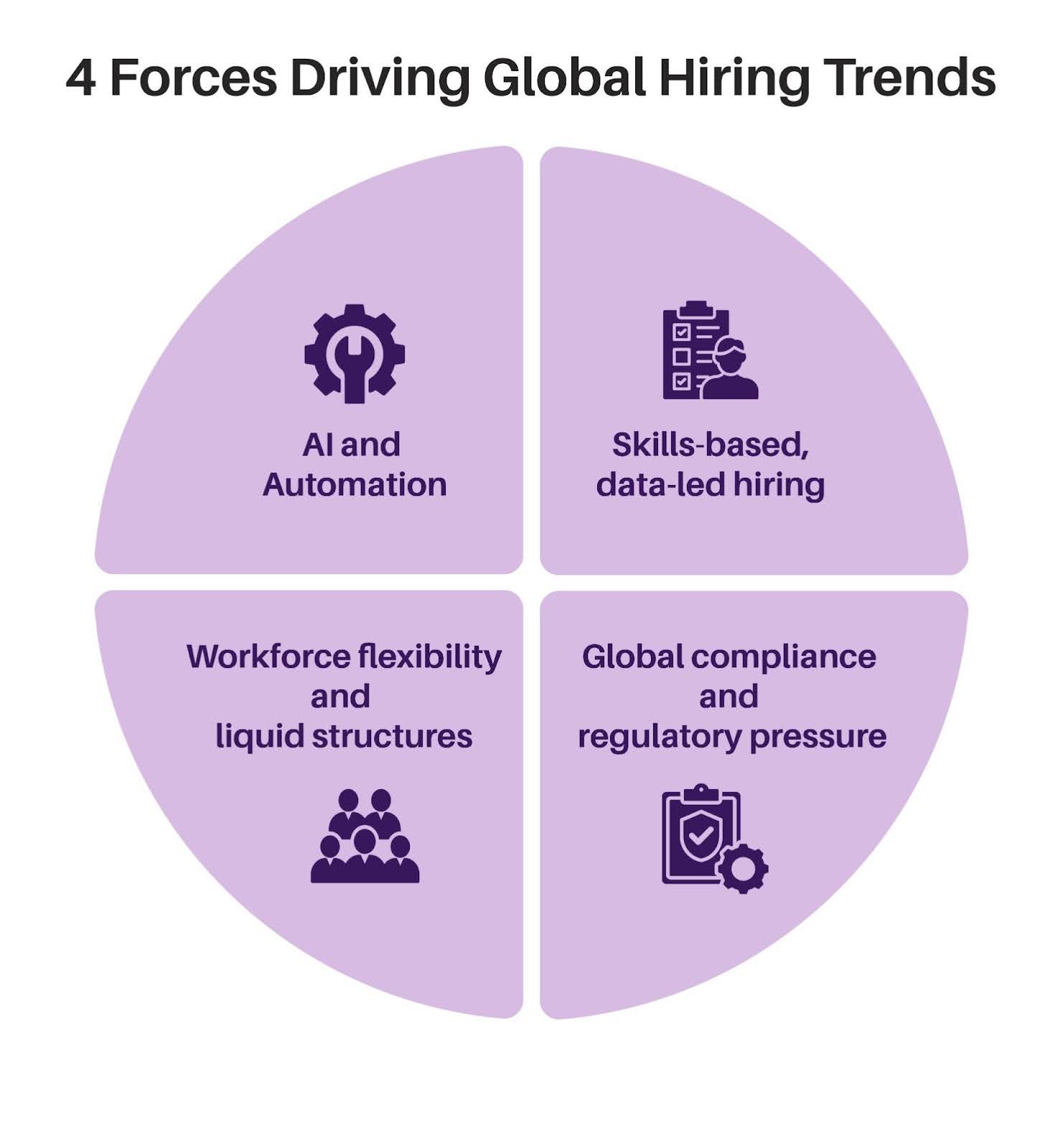
Four forces leading the change:
-
AI and automation
Companies in Australia, Japan, the UK, and the US are moving from basic automation to building mixed teams of people and AI agents. AI handles screening, scheduling, and compliance checks, while managers focus on complex problem-solving and human decisions.
-
Skills-based, data-led hiring
Across all four markets, employers are shifting from degree-first criteria to skills-first hiring backed by analytics. Micro-credentials, internal learning platforms, and talent data guide who is hired, promoted, or redeployed, helping close shortages in areas such as AI engineering, cybersecurity, healthcare, and renewable energy.
-
Workforce flexibility and liquid structures
Australia and the US are seeing rises in fractional leadership, contract specialists, and gig professionals, while the UK and Japan are formalising hybrid and remote models. This “liquid” workforce gives employers access to niche skills on demand, but requires careful handling of employment status, benefits, and performance expectations.
-
Global compliance and regulatory pressure
In Japan and the UK, new labour and data rules, AI governance, and social insurance requirements increase the cost of missteps. For multinational teams that span Australia, the US, and Asia-Pacific, the main constraint is no longer finding talent but managing payroll, tax, immigration, and data protection accurately in each country.
Independent findings show that hiring priorities are shifting worldwide. PwC’s 2024 Workforce Hopes and Fears Survey revealed that 45% of workers face faster role changes, and over half of leaders are restructuring work through AI and automation.
This matches what Eos and Hightekers see in markets such as Australia, Japan, the UK, and the US: faster role evolution, higher expectations on flexibility, and rising pressure on compliance.
These dynamics explain why Employer of Record (EOR) and Professional Employer Organisation (PEO) models are becoming central to expansion — enabling firms to hire compliantly across multiple jurisdictions without the cost or delay of establishing local entities.
What Defines the Global Hiring Landscape in 2026
AI-Driven Recruitment and Predictive Talent Analytics
Artificial intelligence continues to redefine recruitment. It now supports end-to-end processes — from candidate sourcing and assessment to onboarding and compliance tracking.
According to LinkedIn’s Future of Recruiting report, 74% of talent professionals believe AI will be a major part of their recruitment process, and 87% say talent acquisition has become a more strategic business function. These findings reinforce that automation is augmenting decision-making, not replacing human expertise.
See also How AI and Automation Will Transform Global HR & EOR in 2026 for a deeper look at how automation strengthens compliance and workforce agility.
Hybrid Work as a Permanent Global Model
Hybrid work has moved from experiment to expectation. Across Europe, Asia, and North America, businesses are formalising remote policies that comply with local employment rules.
Through its partnership with Hightekers, Eos supports compliant hiring in 27 countries, ensuring payroll, social contributions, and statutory benefits are handled correctly.
Compliance Automation and Digital Governance
Cross-border compliance no longer demands in-country HR teams. Digital platforms now automate filings, tax deductions, and benefits, reducing penalties and delays. Examples include IR35 compliance in the UK and Shakai Hoken in Japan — both managed seamlessly within Eos’s EOR framework.
Learn more about EOR requirements and compliance across different countries in the Eos Country Hiring Guide.
How EOR and PEO Models Are Redefining Global Expansion
The Shift from Entity Setup to On-Demand Global Hiring
Traditional entity setups tie up time, capital, and local legal administration. In 2026, companies prefer flexible models that prioritise agility and compliance.
Establishing a foreign entity can take months and require substantial capital. In contrast, EOR and PEO models offer faster, lower-risk access to global markets.
Quick Comparison:
- EOR (Employer of Record): Becomes the legal employer, manages contracts, tax, payroll, and statutory benefits.
- PEO (Professional Employer Organisation): Offers co-employment for firms that already have an entity but seek HR outsourcing.
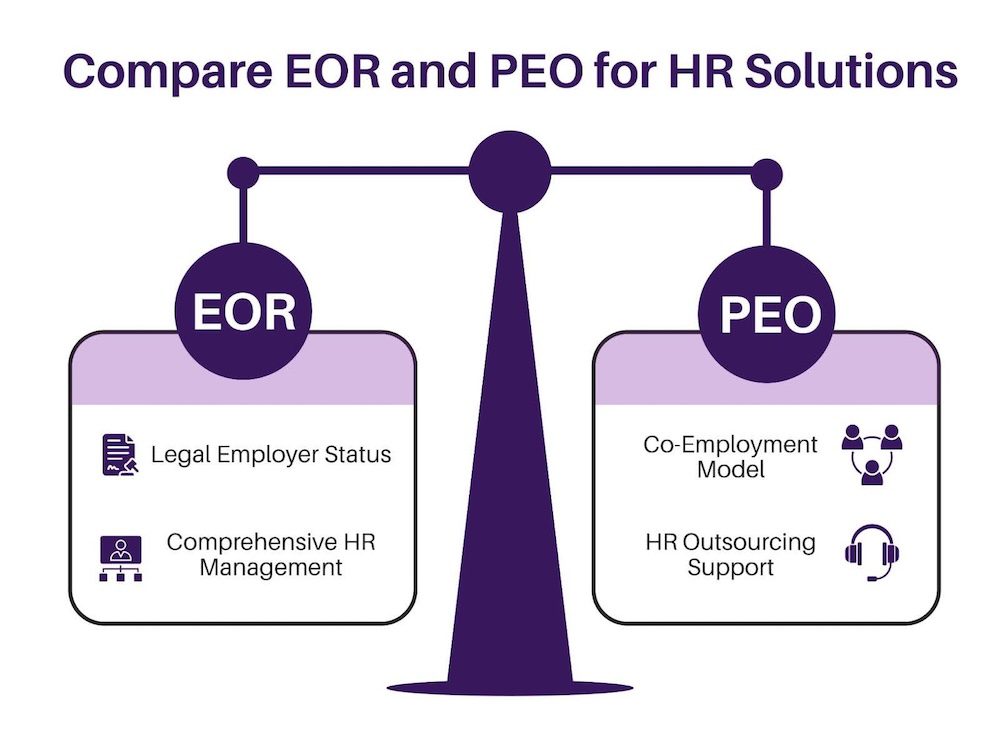
Eos’s EOR Services provide the fastest route to hire talent internationally without establishing subsidiaries, in days, not months.
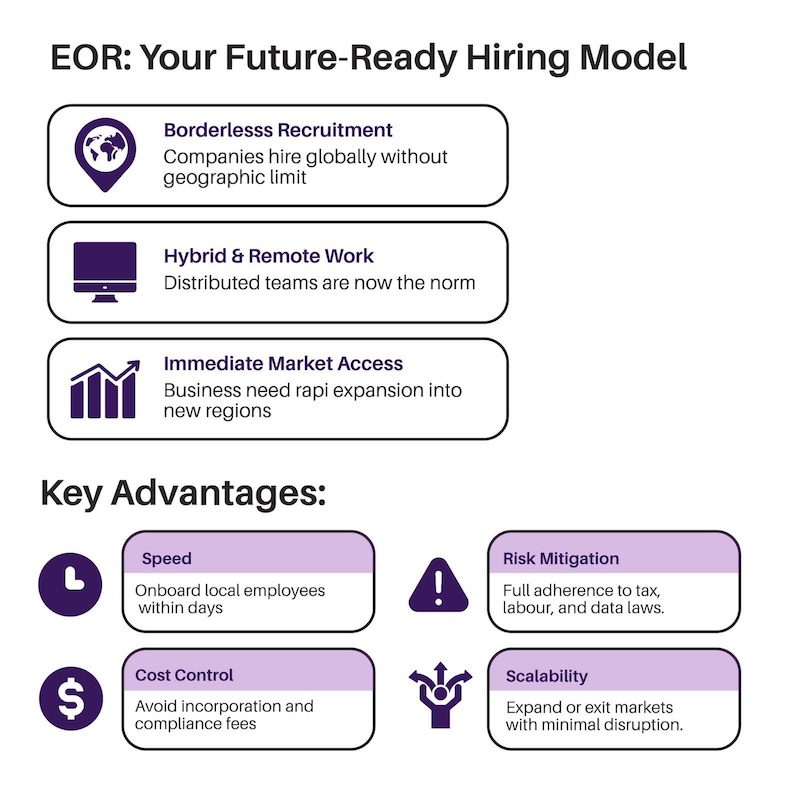
Why EOR Is Becoming the Default Hiring Model in 2026
EOR is emerging as the default hiring model in 2026 as companies prioritise borderless recruitment, hybrid work, and rapid access to new markets. By removing the need for local entity setup and ensuring full compliance from day one, EOR enables faster onboarding, tighter cost control, reduced legal risk, and smooth scalability, making it the most efficient path for global expansion.
Eos’s boutique approach ensures direct access to senior experts who balance automation with human judgement.
The Eos + Hightekers Partnership: Extending Reach Across 27 Countries
Eos and Hightekers combine local presence with global oversight, covering Asia, Oceania, and Europe. From Japan to the UK, businesses gain compliant entry with local expertise and centralised oversight.
Learn more via Global EOR Services.
The Future of Work 2026 — Human Expertise Meets Automation
Technology will continue transforming HR operations, but people remain central to decision-making. Eos integrates automation with legal expertise and cultural insights, ensuring compliance is maintained without losing the human connection.
The Future of Recruiting report highlights that hiring success increasingly depends on human skills such as adaptability and collaboration, even as automation expands recruiting capacity.
For more insights, visit the Eos Trends & Insights hub.
What Global Teams Should Do Now to Stay Competitive
-
Align Hiring Strategy with Predictive Insights
Use workforce analytics to forecast hiring needs. EOR platforms offering real-time data unify HR and finance teams under a single compliance view.
-
Build Scalable Compliance Frameworks
Eos helps prevent compliance issues before they occur — managing payroll, benefits, and taxation across all jurisdictions accurately.
-
Combine Hybrid Work with Local Employment Protection
Cross-border teams require equitable benefits, tax compliance, and data security. Eos ensures these remain standardised globally.
What are the Country-Level Hiring Trends for 2026?
Europe — Tightened Compliance and Labour Fluidity
EU-wide legislation, such as the AI Act and Digital Worker Rights Directive, is reshaping HR governance. Eos covers key European markets, including the UK, France, and Germany — ensuring policy alignment and local transparency.
As the UK refines its employment landscape, understanding evolving worker protections and employer responsibilities is vital for 2026 planning.
Read more in Employment Conditions in the UK: Why EOR Is Your Competitive Advantage in 2025.
Asia-Pacific — Borderless Hiring Acceleration
Asia’s digital economy is driving global-first hiring strategies. Markets like Singapore, Malaysia, and Japan are experiencing surges in cross-border roles managed via EOR frameworks. Eos and Hightekers jointly enable compliant hiring across these regions.
The region’s growth momentum is closely tied to ASEAN’s policy direction and labour mobility initiatives.
Read how upcoming regional cooperation will shape employment and expansion in 2026 — Understanding the 2025 ASEAN Summit in Malaysia: What’s at Stake.
North America — PEO Growth Among Mid-Sized Enterprises
In the United States and Canada, PEO adoption continues to expand as companies outsource HR to remain agile and compliant. For multinational employers, combining PEO for domestic operations with EOR for international hiring provides unified workforce oversight.
Regulatory updates and immigration reforms are also reshaping how global employers approach U.S. hiring.
Learn how recent policy changes — including the $100,000 H-1B Visa Fee — are influencing expansion strategies in 2026.
Conclusion: The Outlook for Global Hiring in 2026
By 2026, global hiring will be defined by precision, agility, and compliance.
AI-driven tools are reshaping recruitment efficiency, while human insight ensures decisions remain ethical and culturally aware. Hybrid and borderless teams are now standard, supported by technology that simplifies payroll, data protection, and employee management across jurisdictions.
EOR and PEO partnerships have evolved from optional to essential. For many companies, they are no longer a shortcut to market entry — they are the infrastructure that sustains long-term international operations.
Eos Global Expansion helps organisations adapt to this reality. With local presence across 27+ countries and partnerships like Hightekers, Eos combines legal expertise, automation, and cultural understanding to help leaders expand safely and sustainably.
In 2026 and beyond, success will belong to employers who build globally — but think locally.
To plan your next stage of growth, speak with Eos Global Expansion today.
FAQs
1. What are the biggest global hiring trends for 2026?
AI recruitment, compliance automation, and hybrid models dominate. EOR partners help organisations hire quickly and lawfully across borders.
2. How does the EOR hiring model improve compliance and reduce risk?
An EOR acts as the official employer, managing payroll, benefits, and legal obligations — protecting businesses from local compliance errors and fines.
3. How do EOR and PEO models differ?
EORs handle full employment responsibility across countries; PEOs manage HR for existing entities through co-employment. Both enhance efficiency but suit different stages of global growth.
4. How does Eos Global Expansion simplify international hiring?
Eos provides end-to-end employment, payroll, and HR support across 27 countries in partnership with Hightekers, ensuring consistent compliance and local insight.
5. Why choose Eos over other global EOR providers?
With 20+ years’ experience, Eos blends legal expertise, cultural understanding, and a service-first approach, giving businesses direct access to senior professionals.
6. How can Eos prepare teams for the future of work in 2026?
Eos integrates automation and expert human oversight to modernise hiring, reduce risks, and align global HR operations with evolving workforce demands.
Book a free consultation with Eos Global Expansion today!